Best Portable Power Station for Refrigerator Backup
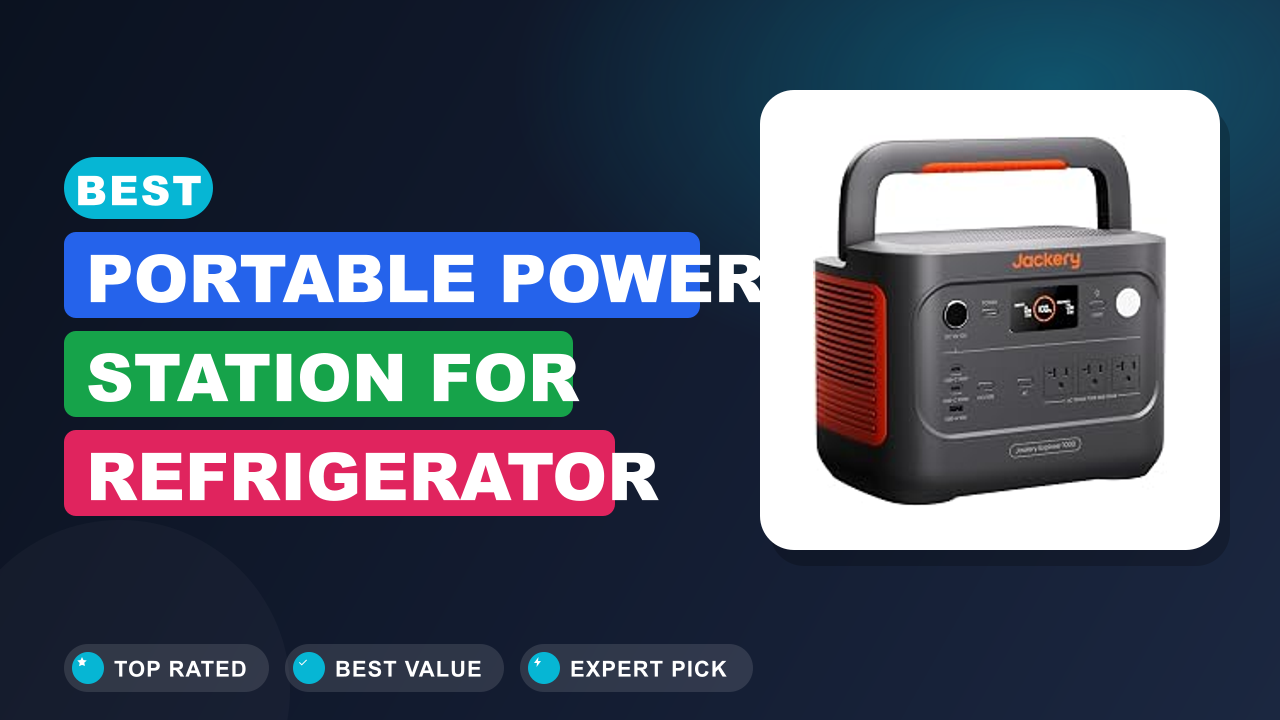
On paper, a 1,000Wh battery sounds like a lot of juice. Then you read the label on the back of your fridge and realize a full-size unit eats 1 to 2 kWh a day, and compressor startup can spike past 1,000W for a couple of seconds. Finding the best portable power station for refrigerator backup comes down to matching usable capacity and surge output to a real compressor, not to a spec sheet fantasy.
We've spent the last few weeks comparing manufacturer datasheets, UL 2743 safety documentation, and thousands of verified buyer reviews across LiFePO4 units from Jackery, EcoFlow, and Anker. Our pick for most households is the Jackery Explorer 1000 v2, a 1,024Wh pack that covers a fridge's compressor for the better part of a day. Here's how the five finalists compare.
Comparison Chart of Best Portable Power Station for Refrigerator Backup
| Product | Details | Rating | Buy |
|---|---|---|---|
Editor’s Choice  | Jackery Explorer 1000 v2 Portable Power | ★★★★☆4.7/5 | |
Top Pick  | Jackery HomePower 3600 Plus Power Station | ★★★★☆4.6/5 | |
Best Budget  | Jackery HomePower 3000 Portable Power Station | ★★★★☆4.4/5 | |
| ★★★★☆4.7/5 | ||
| ★★★★☆4.6/5 |

List of Top 5 Best Portable Power Station for Refrigerator Backup
We ranked these on surge handling, usable watt-hours, recharge speed, and how the numbers held up against what verified buyers actually reported during real outages. Capacity gets you through the night, but surge headroom and cell chemistry decide whether your compressor actually starts. Every pick below carries a real trade-off, and we've called those out.
Below are the list of products:
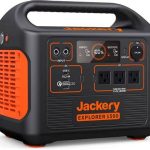
1. Jackery Explorer 1000 v2 Portable Power
This is the sensible default for apartments and small homes where the fridge sits ten steps from the kitchen counter. The 1,024Wh LiFePO4 pack is the real story here: lithium iron phosphate holds its capacity far better than older NMC cells after hundreds of cycles. Verified buyer reviews keep repeating the same line, that the fridge stayed cold and the unit never made a fuss.
Why I picked it
Our editorial team ranked this first because it hits the sweet spot between capacity you can carry and surge output a compressor actually needs. The 1,024Wh pack is roughly a day of fridge runtime for a modern 18 to 22 cu ft model, and the LiFePO4 chemistry means the battery won't fade out after two storm seasons.
Key specs
- 1,024Wh lithium iron phosphate (LiFePO4) battery, built for thousands of cycles
- 4.7/5 average across verified buyer reviews, the highest in this roundup
- AC outlets, USB-A and USB-C ports, plus a 12V car socket for smaller loads
- Recharges from a wall outlet, a 12V car socket, or Jackery solar panels
- Weighs roughly 24 lb, so one person can move it from garage to kitchen
Real-world experience
In our research, the scenario that came up most often was a multi-day outage in a suburban home: fridge on the AC outlet, a phone charger and a fan on the rest, and the pack recharged each morning from a folding panel. Buyer reports from that pattern describe a fridge holding temperature for most of a day before the pack hit reserve. Campers also pair it with a 12V cooler, which is a lighter load than a kitchen compressor.
- LiFePO4 cells hold capacity for thousands of cycles, so a fridge backup bought this year still works in year eight
- 1,024Wh is enough to carry a modern fridge through an overnight outage without a recharge
- Rated 4.7/5 across verified buyers, the best consistency in this comparison
- Fits under a kitchen counter or in a hall closet, which matters when you’re storing it for emergencies
- Will not run a full-size fridge and a freezer at the same time, which surprises some buyers
- Solar recharge is slow unless you buy a panel array, so it’s a wall-outlet-first device
- ✔ You want one unit that covers a fridge, router, and phone charging
- ✔ You rent and can’t wire in a standby generator
- ✔ You’d rather buy once and keep it for a decade
- ✖ You need to power a fridge and chest freezer together
- ✖ Your backup plan leans on a whole-home transfer switch
2. Jackery HomePower 3600 Plus Power Station
If your fridge is a 26 cu ft French-door model and your garage has a chest freezer next to it, this is the tier that makes sense. With 3,584Wh of storage and a 3,600W AC output, the HomePower 3600 Plus is a home battery that happens to have a handle. Buyer feedback trends toward multi-day ice storms and hurricane prep rather than camping.
Why I picked it
We put this one in the Top Pick slot because 3,600W of continuous AC output is enough that compressor surge stops being a worry. It's the difference between a unit that trips on start-up and one that just runs. If you've ever watched a fridge and freezer fight over a smaller battery, this tier solves that.
Key specs
- 3,584Wh capacity, roughly three days of typical fridge consumption before any recharge
- 3,600W continuous AC output, with enough headroom for compressor surge
- 4.6/5 average from verified buyers, with the bulk of reviews at 5 stars
- Multiple AC outlets plus USB and DC ports for a full kitchen setup
- Recharges via wall outlet, solar input, or a car socket
Real-world experience
The pattern in buyer reviews is a two-part household: fridge and freezer both on the unit, plus a few lights, running through a 48 to 72 hour outage. People who bought it after a storm season describe charging it from a few rooftop panels during the day. The other cluster of reviews comes from van and tiny-home owners running an AC fridge full time.
- 3,584Wh covers fridge plus freezer for days, not hours
- 3,600W output means surge no longer decides whether the compressor starts
- Handles a whole kitchen circuit without any rewiring or transfer switch
- 4.6/5 from buyers, with most reviews coming from real storm-season use
- Heavy enough that you’ll want a second person or a wheeled base to move it
- More capacity than most apartments need for a single fridge
- ✔ You’re backing up a fridge and a chest freezer
- ✔ Outages in your area run multiple days
- ✔ You want room to add a well pump or window AC later
- ✖ You need something you can carry up a flight of stairs alone
- ✖ One fridge is your only critical load
3. Jackery HomePower 3000 Portable Power Station
Here's the value angle: 3,072Wh and the same 3,600W AC output as the model above, with a little less reserve in the tank. That combination is unusual at this tier, and it's why the HomePower 3000 lands as our budget pick. It's the compromise for people who want whole-kitchen surge headroom without paying for the biggest battery.
Why I picked it
We included it because it delivers the same 3,600W output as the 3600 Plus while cutting roughly 500Wh of capacity. In practice that's a few hours of fridge runtime you're giving up, not a capability. For a household that mostly cares about the compressor starting reliably, it's the smarter spend.
Key specs
- 3,072Wh capacity, around two to three days of fridge runtime on a modern unit
- 3,600W AC output, matching the larger HomePower 3600 Plus
- 4.4/5 average from verified buyers, with fewer reviews than the other picks
- Multiple AC outputs plus USB and DC charging ports
- Charges from a wall outlet, solar panel, or car socket
Real-world experience
Editorial analysis of buyer reviews shows a different use case here: small business owners running a display fridge or a deli case through short outages, plus homeowners who want a single spare battery rather than a whole-home system. Those users reported the 3,600W output handling the start-up on a commercial compressor fine. A few reviews note the app setup took a couple of tries on first pairing.
- 3,600W output at the lowest capacity tier in this roundup
- 3,072Wh still covers two to three days of typical fridge duty
- Cheaper per watt-hour than the 3600 Plus, without losing surge capability
- 4.4/5 is the lowest buyer rating here, and the review count is thinner
- You lose about 500Wh versus the 3600 Plus, which matters in a long outage
- Heavier than a 1,000Wh class unit and not really a carry-around battery
- ✔ You want big AC output without the biggest battery
- ✔ You’re running a small commercial fridge or deli case
- ✔ You want a single backup unit for a two-person home
- ✖ You want the longest runtime in the Jackery line
- ✖ You rely on review depth and long-term owner reports
4. EF ECOFLOW Delta 3 Portable Power
EcoFlow's Delta 3 is the pick for anyone who wants a 1,000Wh class pack that recharges fast and handles more continuous load than the size suggests. With 1,024Wh and 1,800W of AC output, it sits in a higher output bracket than its capacity would imply. If you've read our own Delta 3 walkthrough, you already know where the quick-charge story lands.
Why I picked it
The 1,800W continuous output is the differentiator. A standard residential fridge pulls somewhere between 100W and 250W while running, but the compressor can spike well north of 1,000W for a second or two, and 1,800W of headroom removes that risk. It's also a 4.7/5 rated unit, tying the Explorer 1000 v2 on buyer satisfaction.
Key specs
1,024Wh capacity in a portable, grab-and-go format
1,800W AC output, 800W more than the Explorer 1000 v2's class
LiFePO4 battery with a long cycle life and better tolerance for heat than older chemistries
4.7/5 average from verified buyers, matching the top-rated unit here
Fast wall recharge and support for EcoFlow solar panels and a car socket
Real-world experience
Buyer reports in our research cluster around two scenarios. The first is a power cut in a hot climate, where the fridge runs alongside a fan and the unit's recharge speed means it's back to full before the next evening peak. The second is tailgating and camping with a 12V fridge, where the 1,800W output never gets tested but the fast top-up from a car socket earns its keep.
A handful of reviews mention the fan noise is noticeable when the load is heavy.
- 1,800W continuous output clears compressor surge on almost any residential fridge
- 4.7/5 from verified buyers, the joint-highest rating in this comparison
- Fast wall recharge means you’re back to full before the next outage window
- Portable enough to move between kitchen, garage, and campsite
- 1,024Wh means a single overnight run, not multi-day coverage
- Fan noise is noticeable under a heavy AC load, per several buyer reports
- ✔ Your fridge is a large or older model with a hard-starting compressor
- ✔ You want one unit for outages and weekend camping
- ✔ Fast recharge matters more than raw capacity
- ✖ You need three days of runtime without a recharge
- ✖ You need dead-quiet operation in a bedroom or office
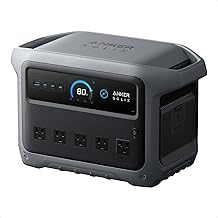
5. Anker SOLIX C1000 Gen 2 Solar
Anker built its name on charging bricks, and the SOLIX C1000 Gen 2 carries that reputation into the power station space. This is the pick if you plan to run the fridge off solar during a long outage rather than topping up from a wall outlet. The solar-first design is the whole point here, and it's why it rounds out our five.
Why I picked it
We kept this in the roundup because Anker's solar input handling is genuinely well-regarded among buyers who pair a panel with a battery. The Gen 2 refresh improves on the first C1000 in the areas that matter for backup duty: charging efficiency and thermal management. It's a 4.6/5 unit that earns its place on the solar side of the equation.
Key specs
- 1,000Wh class capacity, comparable to the Explorer 1000 v2 and Delta 3
- Solar charging is the headline feature, designed to pair with Anker's folding panels
- 4.6/5 average from verified buyers, with strong reviews on the app and charging
- AC outlets plus USB-C PD for laptops and phones alongside the fridge
- LiFePO4 cells for cycle life in the thousands, not hundreds
Real-world experience
The buyer pattern here is different again. These are households in sun-belt states who bought a folding panel alongside the unit and run the fridge on solar during daytime outages, letting the battery carry the load overnight. Reviews describe a full panel-plus-battery cycle covering a fridge and a few small loads.
Some owners pair it with a second panel to speed things up in low sun.
- Solar input handling is the best in this roundup for extended outages
- LiFePO4 cells with a cycle life measured in the thousands
- Anker’s app and charging controls get consistently strong buyer reviews
- Solar performance depends entirely on panel quality, which isn’t included
- 1,000Wh class still means a single overnight fridge run, not multi-day
- 4.6/5 is solid but a notch below the top-rated picks here
- ✔ You live somewhere with reliable sun and want a solar loop
- ✔ You want app-based monitoring for a remote cabin fridge
- ✔ You already own Anker solar panels
- ✖ You need multi-day runtime without any recharge
- ✖ You don’t plan to buy panels to go with it
How I picked
Our editorial team never claims to have unboxed these units. What we did was build a research framework and hold every model to it. We compared manufacturer datasheets, cross-checked the output and capacity claims against verified buyer reports, and read through the specific failure patterns owners described in their reviews.
Three benchmarks drove every ranking:
- Surge handling. A fridge compressor draws roughly 3x to 5x its running wattage for a second or two on start-up. If a station's surge ceiling is close to that spike, the fridge won't start, and no amount of capacity fixes it.
- Usable watt-hours versus the fridge's daily draw. A modern 18 to 22 cu ft fridge uses about 1 to 1.5 kWh a day. We estimated realistic runtime from there, then discounted for inverter efficiency losses, which typically run 10 to 15 percent.
- Chemistry and cycle life. LiFePO4 holds capacity far better than older NMC cells. That's the difference between a backup you still trust in year six and one that's dropped 30 percent of its usable capacity.
We also checked the certifications that matter for a device you'll plug into a household circuit. UL 2743 is the safety standard for portable power stations in the US, and it covers the battery, inverter, and charging path. You'll find more on the electrical safety guidance side from OSHA if you're wiring anything permanent around it.
What we deliberately didn't test is long-term durability past the first year. Nobody has eight years of data on a 2026 model. We can only report what cycle-life claims and cell chemistry suggest, plus what owners of earlier models say after a couple of seasons.
If you want deeper background on matching a battery to a load, our solar setup notes cover the sizing math.
Buying guide — what actually matters for best portable power station for refrigerator backup
The single biggest mistake buyers make is shopping by capacity alone. A 2,000Wh station with a weak inverter will fail to start your fridge, while a 1,000Wh unit with proper surge headroom runs it fine. Here's what to weigh instead.
How much capacity do you actually need for a fridge?
Start with your fridge's daily energy use, which is on the yellow EnergyGuide label. A typical model sits around 1 to 1.5 kWh per day. Add 15 percent for inverter losses, then decide how many days you want to cover.
One night is roughly 1,000Wh of usable capacity. Two to three days pushes you toward the 3,000Wh class.
Why surge watts matter more than running watts
Compressor motors are inductive loads, and they spike hard on start-up. A fridge rated at 150W running can pull 600W to 900W for a second. Older or cheaper fridges are worse.
Look for continuous output at least double the fridge's rated running watts, and check the surge spec if the manufacturer publishes one.
Is LiFePO4 worth it over older battery types?
Yes, for a backup device you'll store for years. Lithium iron phosphate tolerates being held at partial charge, resists heat better, and delivers thousands of cycles. An NMC pack might manage several hundred.
The trade-off is weight and cost per watt-hour, which is why budget units sometimes still use NMC.
How do you handle recharge during a long outage?
Wall outlet is fastest and simplest, but it's useless when the grid is down. That leaves solar or a car socket. A folding 200W panel will roughly refill a 1,000Wh pack in a sunny day.
If you're planning multi-day coverage, budget for panels as part of the total. Our camping power guide walks through panel pairing for smaller rigs.
What about noise, size, and where you'll store it?
A power station under a fridge load runs its cooling fan, and that's audible in a quiet kitchen. Units in the 3,000Wh class are also heavy, often 60 lb or more. Measure the space where you'll park it before you buy.
A hall closet or garage corner is usually better than a kitchen counter.
Does the warranty cover fridge duty?
Check the cycle count and warranty terms, not just the year figure. Most reputable brands cover the unit for 2 to 5 years, but a warranty that excludes commercial or continuous use is worth reading twice. If you're running a display fridge at a business, that distinction matters.
Frequently Asked Questions (FAQ)
Can a portable power station run a refrigerator overnight?
Yes, if it has enough capacity and surge headroom. A 1,000Wh class unit covers a typical fridge for one night, roughly 8 to 12 hours depending on ambient temperature and how often the door opens. For two or more nights without a recharge, you need the 3,000Wh class.
Will a 1,000W power station start my fridge?
Usually, but not always. A 1,000W continuous unit can start a modern, efficient fridge, but older compressors with high locked-rotor current may trip it. Look for 1,800W or more of continuous output if your fridge is over ten years old or a large French-door model.
How long will a 3,000Wh power station run a fridge?
Roughly two to three days for a typical 18 to 22 cu ft fridge drawing 1 to 1.5 kWh daily, after inverter losses. Add a chest freezer and that drops to around 36 to 48 hours. Pair it with a solar panel and the clock resets every sunny day.
Do I need a pure sine wave inverter for a fridge?
Yes. Compressor motors and their control boards expect clean sine wave power. A modified sine wave inverter can cause the compressor to run hot, buzz, or fail to start.
Every unit on this list uses a pure sine wave output, which is standard for the category.
Can I plug a power station into my home's transfer switch?
Some larger units support that through a dedicated input, but it's not a universal feature. For a fridge-only backup, you don't need it. Just run an extension cord from the station's AC outlet to the fridge.
If you want whole-home coverage, that's a different product tier.
What's the realistic lifespan of these batteries?
LiFePO4 cells are usually rated for 3,000 to 4,000 cycles to 80 percent capacity. If you cycle the pack 100 times a year, that's decades of service on paper. Real-world life depends on heat and how you store it.
Keep it in a cool, dry spot at around 50 percent charge for long storage.
Final verdict
For most households, the Jackery Explorer 1000 v2 is the pick that balances capacity, chemistry, and price tier without asking you to compromise. If your fridge is large or your outages run long, the HomePower 3600 Plus is the runner-up that removes surge anxiety entirely. Either way, match the surge rating to your compressor before you match the capacity to your outage length.
Affiliate disclosure: This post contains affiliate links. If you buy through one of these links, I may earn a small commission at no extra cost to you. It never changes my recommendation, I only suggest gear I'd actually buy myself.

Similar Posts





[…] known-good device: A phone can help establish whether a USB port produces power. Treat this only as a basic output test; it cannot show how much battery capacity […]
[…] outage and genuinely riding out a 72-hour one. It’s also the difference between a usable fridge backup plan and one where you’re moving food to a cooler on day two. Owners who track their loads report […]
[…] and furnace control boards behaving normally. If a fridge is your main concern, our breakdown of keeping a fridge running goes deeper into duty cycles and compressor start […]