Solar panels in series or parallel with MPPT: 2026 Guide
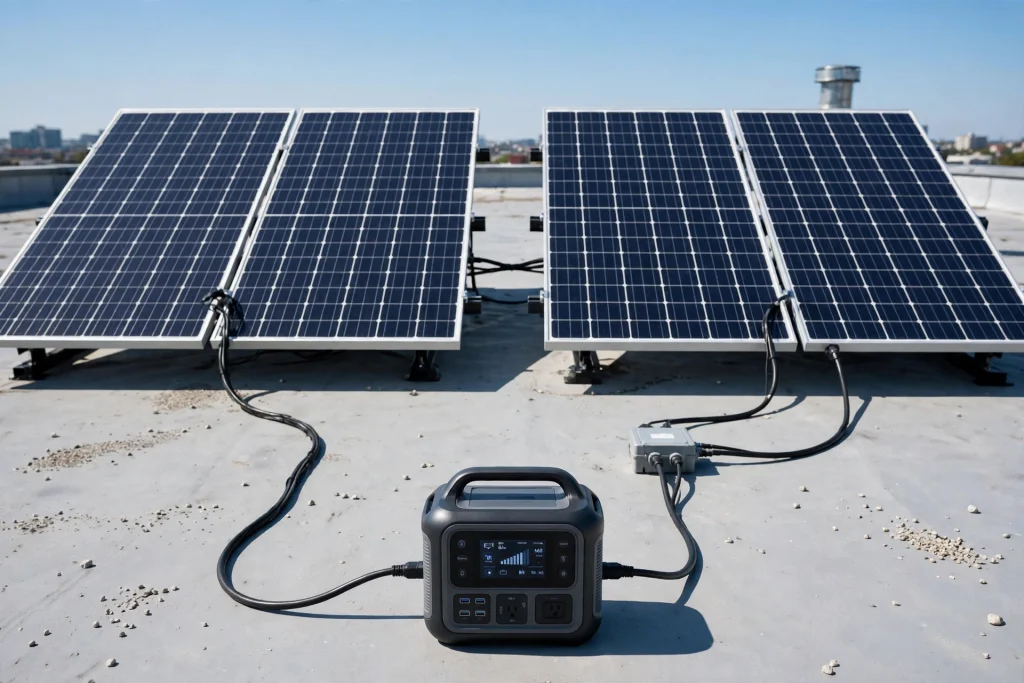
For solar panels in series or parallel with MPPT, series is usually the better choice when the controller has enough voltage headroom, because it raises array voltage while reducing current for the same panel wattage. Parallel wiring suits lower-voltage requirements or layouts where panel shading differs. Choose only after checking cold-weather open-circuit voltage, operating range, and current limits against the equipment.
Key Takeaways
- Series wiring raises array voltage; parallel wiring raises array current, while panel and controller limits determine which configuration fits.
- MPPT compatibility depends on cold-weather open-circuit voltage, operating voltage, startup requirements, and input-current limits—not just advertised wattage.
- Parallel wiring does not eliminate shading losses; panel layout, bypass diodes, and tracker inputs affect how shade changes output.
- For comparable panels, wiring changes the voltage and current balance, not the array’s theoretical total power.
Solar panels in series or parallel with MPPT: the short answer
Series is often the better choice when an MPPT controller needs more array voltage, especially on a longer cable run, as long as the string stays within the controller’s voltage limits. Parallel wiring suits systems that need lower array voltage or separate strings, but the MPPT input and wiring must handle the combined current. A series-parallel layout can work for a larger array when its string arrangement fits the equipment limits and panel layout.
Neither configuration adds nameplate power when you connect the same panels differently: series raises voltage, while parallel raises current. For example, a panel’s Vmp describes its voltage at maximum power; its Voc is a separate value that matters when checking the controller’s maximum voltage, particularly in cold weather.
The exact inverter or charge-controller model and its manual determine which configurations are permitted. When comparing solar panels in series or parallel with MPPT, choose from those limits and the site’s shade and cable-run conditions, not from a blanket rule that one layout is always better.
Side-by-side comparison
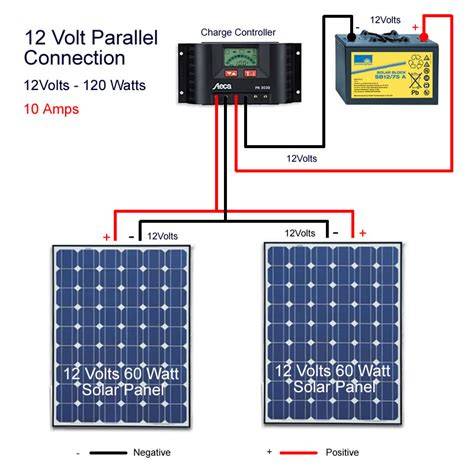
Series wiring adds panel voltage while current stays at one panel’s level; parallel wiring adds current while voltage stays at one panel’s level. The table uses an illustrative set of four modules, each with a Vmp of 40 V and an Imp of 10 A. These figures explain the arithmetic, not a system design.
| Comparison | Series | Parallel |
|---|---|---|
| Operating voltage and current | 160 V Vmp, 10 A Imp | 40 V Vmp, 40 A Imp |
| MPPT fit | Higher voltage may suit a tracker that needs more operating voltage; check startup and operating ranges. | Lower voltage may suit a lower-voltage setup; check the tracker’s voltage range. |
| Cold-weather check | Add module Voc values, then assess cold-weather rise against the controller’s maximum PV voltage. | Each module’s cold Voc still must fit; parallel wiring does not remove the voltage limit. |
| Shade and mismatch | Shade or mismatch in a string can affect its output; bypass diodes influence the effect. | Separate parallel branches can limit some mismatch effects, but shading still reduces output. |
| Cable and protection | Lower current can reduce conductor losses on a long run; check cable voltage rating and string protection. | Higher current can require heavier conductors; check input-current limits and whether string fuses are required. |
The illustrative arrangements have the same theoretical array power: 1,600 W at their stated operating points. Real output depends on module conditions and system limits. Voc is open-circuit voltage, not operating Vmp, so use cold-adjusted Voc for the maximum-voltage check.
How I Evaluated These Wiring Options
I weighed the controller’s MPPT operating range, startup voltage, maximum PV voltage, input-current limits and how its trackers are allocated. These limits answer different questions: a string must reach the tracker’s operating range, stay below the maximum voltage and keep its current within the controller’s rating. For solar panels in series or parallel with MPPT, DC (direct current) is the panel-side electricity whose voltage and current must fit the controller’s input limits.
Cold conditions raise Voc, while heat can lower operating voltage. I also considered orientation, shade pattern, cable run and protection needs. Treat this as a comparison framework, not approval of a string plan; use current manufacturer manuals and local electrical requirements for project-specific design.
MPPT voltage and current fit: series wins when the tracker needs more voltage
Series wiring raises string voltage; parallel wiring raises array current while keeping voltage near that of one panel. Series is the conditional winner when it reaches the MPPT’s operating range and cold-weather open-circuit voltage (Voc) stays below the controller’s maximum. Neither layout is suitable unless it also meets the other equipment limits. For solar panels in series or parallel with MPPT, this voltage-and-current check is essential.
| Check | Series | Parallel |
|---|---|---|
| Operating voltage | Adds across panels | Stays near one panel’s voltage |
| Operating current | Stays near one panel’s current | Adds across panels |
| Best fit | MPPT needs higher voltage | Higher string voltage conflicts with the system design |
| Main constraint | Cold-string Voc must stay below the maximum | Combined current must stay within the input limit |
Use the panel and controller datasheets together. Check hot-case maximum power voltage (Vmp) against the MPPT operating range, cold-case Voc against maximum PV voltage, and startup voltage separately. Then check operating current, short-circuit current (Isc), and any limits for each tracker. A total inverter rating or the number of PV sockets does not tell you whether those sockets have independent MPPTs or what each input permits.
For instance, two panels rated at 30 V Vmp and 10 A each produce 60 V at 10 A when connected in series, or 30 V at 20 A when connected in parallel. Both arrangements have the same ideal power, but each may be appropriate for different voltage and current constraints. A cold-voltage calculation is also important: at a cold-case Voc of 52.5 V per module, a string of eight reaches 420 V, under the assumed 500 V limit. However, at a hot-case Vmp of 30 V per module, those eight modules yield just 240 V—below the tracker’s 250 V operating requirement. These figures are examples, not approval of a design.
Parallel can be preferable when a higher-voltage string conflicts with the controller or system design, provided its combined current remains within every applicable input limit.
Shade and mismatch: parallel can win for separated array conditions
Parallel strings or separate MPPT allocation win when array sections face different orientations or have different shade patterns, provided the equipment supports that layout. A series string’s modules share an electrical path, so shade on one module can affect the string’s operating point. Bypass diodes can route current around shaded cell groups, but the effect depends on the module and shade pattern. For solar panels in series or parallel with MPPT, tracker allocation and array conditions matter alongside the wiring choice.
| Array condition | Better fit | Why |
|---|---|---|
| One evenly lit, same-orientation string | Series | Keeps string current lower; shade is less of a concern |
| Separate strings with different shade patterns | Parallel, if the tracker supports it | Strings connect in parallel, but still share the tracker’s operating limits |
| Different orientations or persistent shade zones | Separate MPPT inputs, if available | Each tracker can follow its connected array independently |
Wiring panels in parallel does not protect each one from shading or mismatch effects. Modules within a string on the same MPPT remain subject to shared voltage and current limits, and shade on one module can lower the string’s output. If a brochure lists 30 A across two inputs but the detailed specifications allocate 15 A to each tracker, use the per-tracker rating to assess the proposed connection.
Do not combine modules based only on matching nameplate wattage. Compare their electrical characteristics, including operating voltage and current, and account for the string layout. I recommend checking the module and inverter manuals, then asking the system designer to map each module to its string, orientation and shade exposure before choosing the wiring.
My verdict: I would choose parallel strings or separate MPPT allocation for distinct shade or orientation zones only when the controller supports them. For one consistent, unshaded array, I would not accept extra wiring complexity just to use parallel.
Cable, protection, and installation value: series often wins on long runs
For a long cable run, series is the conditional winner: higher voltage and lower current can allow a suitable conductor design with lower resistive losses. Both are 1,600 W at the modules’ operating point, before system losses. When choosing solar panels in series or parallel with MPPT for a long run, confirm that the controller has enough voltage headroom.
| Installation factor | Series | Parallel |
|---|---|---|
| Array current in this example | 10 A | 40 A |
| Long cable run | Often easier to design for lower current | Higher current can require a different conductor design |
| Connections and protection | Must suit the string and its voltage | Combined current may affect connectors, combiner equipment and overcurrent protection |
| Main constraint | Higher voltage must stay within every equipment rating | Combined current must stay within every equipment rating |
The lower-current advantage does not make series automatically cheaper or safer. Its higher voltage requires checks against the equipment’s voltage ratings and applicable installation rules. Parallel wiring may need components rated for the combined current; whether fuses or other protection are required depends on the array design, equipment and local electrical code.
I would compare complete, documented installation scopes, including cable length and gauge, connectors, protection and any combiner equipment. Panel wattage or wire size alone cannot show which quote delivers better value. My verdict: I favor series for a long run when the controller and other equipment have adequate voltage headroom; I would choose parallel when the system’s voltage limits or layout make it the better fit.
Pricing and value: the equipment match matters more than the label
Series wiring does not have a fixed price premium over parallel wiring, or vice versa. The total depends on the installation: cable length and conductor size, connectors, combiner equipment, fuses or breakers, and whether the inverter or MPPT controller accepts the proposed voltage and current. For solar panels in series or parallel with MPPT, the equipment match—not the wiring label—determines whether the installation scope is suitable.
A series layout may reduce cable requirements on a long run, but higher string voltage must remain within the equipment’s limits. A parallel layout can require components rated for the combined current. A quote that looks cheaper may be unsuitable if its design exceeds a controller limit or relies on undocumented workarounds.
For a fair comparison, ask each installer to list the exact solar module and inverter or controller models, show the string schedule, and provide the voltage and current checks for the proposed configuration. The quote should also identify which connectors and protection components are included, and who is responsible for any required combiner equipment. Compare the same installation scope, not just the panel total or wiring label. Without a defined system and location, a claimed price difference or saving is not meaningful.
Which solar panels in series or parallel with MPPT fit your setup? Four common situations
Choose the wiring layout that fits the controller and site, not a general rule. Series raises array voltage; parallel raises current, so each can suit a different installation.
- Long cable run: A higher-voltage series string may reduce current and cable losses, provided the controller accepts the string’s voltage. Check cold-weather Voc, hot-weather Vmp, array current and every equipment limit before choosing; high cold Voc can rule out a series layout.
- Low-voltage controller or limited series headroom: Parallel may keep array voltage lower while increasing current. Check cold Voc, hot Vmp, combined current and the controller’s specific voltage and current limits. The controller must still receive enough voltage to start and operate.
- Separate roof faces or different shade patterns: Separate MPPT trackers, if the equipment supports them, can let differently oriented or shaded groups operate independently. Check cold Voc, hot Vmp and current for each tracker, along with its equipment-specific limits.
- A small array of matching modules: Don’t assume parallel is simpler. Follow the controller’s permitted configurations, then check cold Voc, hot Vmp, current and all equipment-specific limits for the selected wiring.
My verdict: I would evaluate series first for a long run when voltage headroom allows, and parallel when series voltage is the constraint. For mixed roof conditions, I’d prioritize suitable separate trackers.
Choose series if… Choose parallel if…
Choose the configuration only after checking the panel and MPPT specifications together. Series raises array voltage; parallel raises array current, so each can suit a different controller limit and cable layout. For solar panels in series or parallel with MPPT, use the equipment specifications to make the choice.
- Raises voltage, which can suit an MPPT that needs a higher PV voltage.
- Lower current for the same array power can reduce cable losses on a long run.
- Matching panels can be wired with fewer parallel branches.
- Cold-weather Voc rises as panel temperature falls and must stay below the controller’s maximum.
- Hot-weather Vmp can fall, so the string still needs enough voltage to operate.
- Shading or mismatch within a string can reduce its output.
My verdict: I’d choose series when the tracker needs more voltage, the cold-Voc calculation passes, and the cable run favors lower current. I would skip it if any model-specific voltage limit is exceeded.
- Keeps array voltage closer to one panel’s operating voltage.
- Raises current, which can suit a system with a compatible input rating.
- Can fit a layout where grouping panels in parallel is useful.
- Combined current must remain within the MPPT’s limits.
- Higher current can require heavier wire or additional protection.
- Parallel wiring does not prevent shade losses within an affected panel or string.
My verdict: I’d choose parallel when the array voltage and combined current fit the equipment and the planned layout benefits from that grouping. If you cannot verify the controller’s voltage, current and protection requirements against the exact panel data, ask a qualified installer to review the design.
Final Verdict
For Solar panels in series or parallel with MPPT, I recommend series as the default when the controller’s voltage limits and the array’s shade conditions support it. Series wiring raises voltage while keeping string current lower, which can reduce cable losses on a longer run. The trade-off is that the string’s cold-weather open-circuit voltage must stay below the controller’s maximum, and shading on one panel can affect the string.
Choose parallel when the controller can handle the combined current and the system benefits from a lower array voltage or separate panel groups. It is not automatically better in partial shade: panel layout, bypass diodes, and whether the panels share a tracker all matter. Higher current can also mean heavier wire and suitable string protection.
Before settling on either layout, compare the panel’s Voc and Vmp with the controller’s cold-voltage, hot-operating-voltage, startup, operating-range, and current limits. The advertised wattage alone does not establish compatibility. For a larger array, a series-parallel arrangement or separate MPPT inputs may fit better, provided the equipment supports that configuration.
My verdict: I would choose series when the controller has sufficient voltage headroom and shading is limited; choose parallel when its current capacity and site layout make that the safer fit.
Related reading:
Frequently Asked Questions
Should I wire solar panels in series or parallel with an MPPT charge controller?
Series wiring is usually the better fit when an MPPT controller needs higher array voltage and the panels receive similar sunlight. Parallel wiring suits a controller that supports the combined current and an installation that needs lower array voltage. Check cold-weather Voc, operating voltage, startup requirements and current limits before choosing.
How many solar panels can I connect in series to my MPPT?
The maximum number of panels in series depends on each panel’s cold-weather Voc and the MPPT controller’s maximum PV input voltage. Add the panels’ adjusted Voc values for the coldest design conditions, then compare the total with the controller limit. Also check that hot-weather Vmp stays within its operating range.
How do I calculate maximum series voltage in cold weather?
Use the panel manufacturer’s Voc temperature coefficient and the lowest design temperature to calculate each panel’s cold-adjusted open-circuit voltage, then multiply by the number of panels in the string. Compare that total with the controller’s maximum PV input voltage. Do not use Vmp for this safety limit.
Are parallel solar panels better for partial shade?
Parallel wiring can limit the effect of shade on other panels when each panel operates on its own parallel branch, but it does not eliminate shade losses. Bypass diodes, panel mismatch and shared MPPT tracking affect the result. Separate MPPT inputs can help when arrays face different directions or have different shade.
Can I mix different solar panels on the same MPPT?
Different panels can share an MPPT only when their electrical characteristics and wiring configuration are compatible. In series, current mismatch can restrict string output; in parallel, voltage mismatch can reduce performance. Compare each panel’s Vmp, Imp, Voc and Isc, and check the controller’s input limits before combining them.
Can series and parallel strings connect to one MPPT input?
Series-parallel strings can share an MPPT input when the strings have compatible voltage and current characteristics and the combined values stay within the controller’s limits. For example, two strings with an operating current of 10A each deliver 20A in parallel. Different orientations or shade conditions may call for separate trackers.

Similar Posts