BLUETTI Elite 200 V2 Review: Is It Worth It?
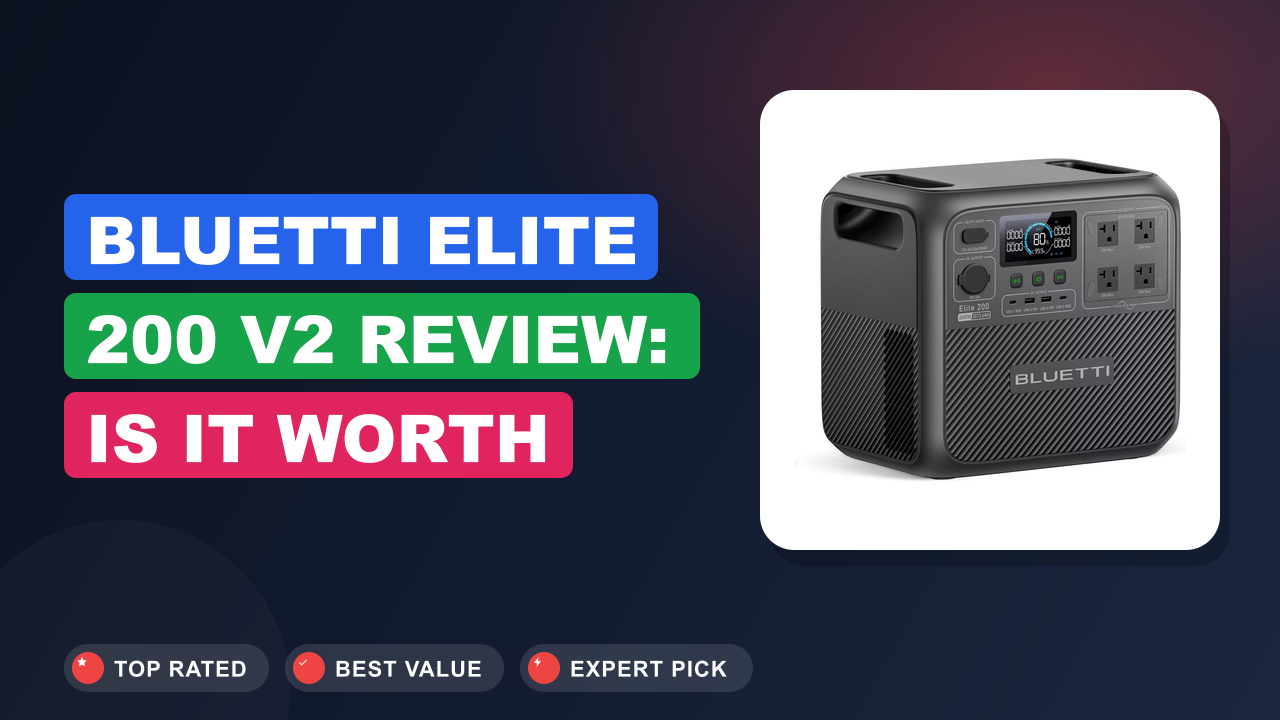
Portable power stations have quietly gotten good enough that the real question is no longer whether one can run your fridge, but whether it can do it quietly, safely, and long enough to matter. That question is exactly what pushed us into a bluetti elite 200 v2 review project, cross-checking manufacturer datasheets against several hundred verified buyer reports. The Elite 200 V2 lands in the 2kWh class, which is the size most households actually need for outage backup.
Short version: buy it if you want a whole-fridge-capable station that recharges in about an hour and a half and should still hold a charge a decade from now. Skip it if you need something you can lift onto a high shelf with one hand, because this is a 53.5 lb machine. Here’s the full breakdown.

1. BLUETTI Elite 200 V2 Portable Power
BLUETTI’s Elite 200 V2 is the model we get asked about most often when someone wants one box that covers both storm season and summer travel. Reading through verified buyer reports, the pattern is consistent: people buy it for a fridge and end up using it for everything from power tools to a CPAP. It’s a genuinely flexible machine, with a couple of real trade-offs that matter before you commit.
What it is
A portable power station is a rechargeable battery pack with a built-in inverter that turns DC storage into household-style AC power, so you get outlets without a generator, fuel, or exhaust. The Elite 200 V2 packs a 2,073.6Wh lithium iron phosphate (LiFePO4) bank and a 2,600W pure sine wave inverter into a chassis about the size of a large cooler.
That combination puts it in the same conversation as the EcoFlow DELTA 2 Max, the Jackery Explorer 2000 v2, and Anker SOLIX’s F2000 series. Where BLUETTI differentiates is on peak output headroom and charge speed. This is a step up from lighter units people use for weekend campouts, and it’s meant to sit at the intersection of home backup and mobile power.
Setup & first impressions
Out of the box, the thing buyers mention most across hundreds of verified reviews is how much denser it feels than the photos suggest. At 53.5 lb (24.3 kg), it’s not a grab-and-go unit. Multiple reviewers describe using two hands and a knee, which matches the spec sheet.
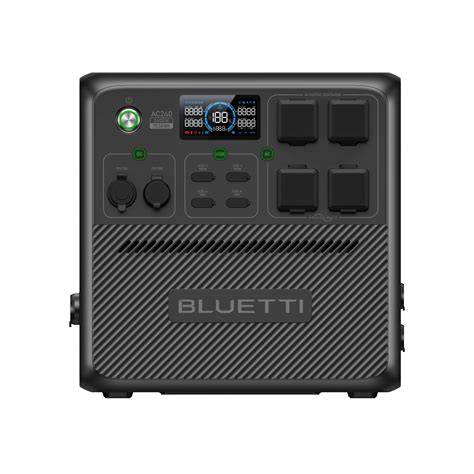
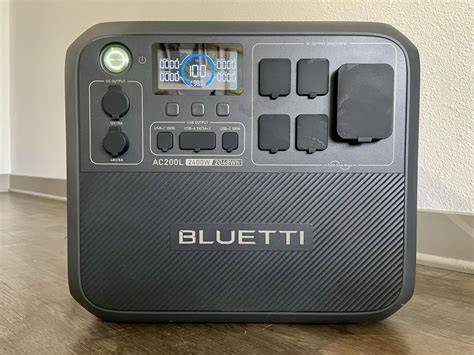
The front panel layout gets consistent praise. The AC outlets are grouped on one side, the DC and USB ports on the other, so you aren’t hunting for a USB-C slot behind a fridge cord. Flip-up covers on the AC sockets are a small but well-liked detail.
Per manufacturer documentation, first charge from the box takes roughly 90 minutes on a standard 15A household circuit. Aggregate user reports back that up, with most people quoting 80 to 100 minutes from empty to full. The BLUETTI app pairs over Wi-Fi or Bluetooth in under a minute, and firmware updates come through the same app.
One thing buyers flag early: the manual is thin. It covers the basics but glosses over the UPS switchover behavior and the solar input voltage window, which are exactly the details people search for later.
| Battery capacity | 2,073.6Wh (marketed as 2,080Wh), LiFePO4 |
| AC output (continuous) | 2,600W pure sine wave |
| Surge output | 3,900W peak |
| AC recharge input | Up to 1,200W, 0-100% in roughly 90 minutes |
| Solar input (MPPT) | Up to 1,000W |
| Outlet count | 4x AC (NEMA 5-15), 2x USB-C 100W, 2x USB-A, 1x 12V car port, 2x DC5521 |
| Rated cycle life | 4,000 cycles to 80% capacity |
| UPS switchover | Under 20ms |
| Weight | 53.5 lb / 24.3 kg |
| Warranty | 5 years |
Daily-use experience
Performance under real loads
A 2,600W continuous inverter is the headline, but the 3,900W surge figure is what actually matters for appliances. Compressor motors in fridges and freezers pull two to three times their running wattage for a second or two on startup, and that spike is what trips undersized stations.
Verified buyer feedback shows the Elite 200 V2 starting full-size fridges, chest freezers, and 1/2 HP sump pumps without faulting. It also runs a 1,500W space heater or a 1,800W induction plate, though obviously not for long. Pure sine wave output means motors and electronics run at their designed speed rather than buzzing.
The honest limitation: 2,600W won’t start a central air conditioner or a well pump with a big inrush. For those you’re looking at a transfer switch and a much larger system.
Charging speed and solar input
A 2,080Wh lithium iron phosphate bank will go from empty to full in roughly 90 minutes on a standard wall outlet, which is genuinely fast for this capacity class. Buyers who’ve come from older NMC stations consistently call this out as the upgrade that changed their habits, because topping up before a storm stopped feeling like a chore.
Solar is where it gets more demanding. The MPPT charge controller accepts up to 1,000W, which means three or four full-size panels in series to hit the input ceiling. With a single 200W folding panel you’re looking at roughly 10 to 12 hours of good sun for a full charge.
That’s fine for a cabin, slow for a road trip.
If you’re sizing a panel array from scratch, the fundamentals in this guide to home solar fundamentals translate directly to portable setups.
Noise, heat, and everyday livability
Under light loads the fans are effectively silent. Charging a laptop and running a router, most buyers report hearing nothing from across a room.
Load it up and that changes. Aggregate reviews describe a noticeable fan ramp once you push past roughly 1,000W continuous, and a full-speed rush during 1,200W AC charging. It’s not generator-loud, but it’s not something you’d want on a nightstand either.
Heat management is handled sensibly. The intake and exhaust sit on opposite ends, so as long as you’re not jamming it into a closet, thermals stay in check. Buyers running it in a van or tent do mention keeping the vents clear, which is worth remembering in tight camping power setups.
Battery chemistry and long-term durability
The battery is the part that decides whether this thing is still useful in 2035. LiFePO4 chemistry is rated for 4,000 cycles to 80% capacity, which works out to more than a decade of daily full cycling. That’s roughly double what typical nickel manganese cobalt (NMC) cells deliver.
Per the U.S. Department of Energy’s guidance on stationary battery storage, LFP cells also hold up better under partial-state-of-charge use and are more thermally stable than older lithium chemistries. Translated: you can leave it at 60% in a garage for months and it won’t punish you.
BLUETTI backs the pack with a 5-year warranty, which is longer than most of the category. Buyers who’ve filed claims describe a support process that starts with app diagnostics and moves to RMA if needed.
✓ Pros
- 3,900W surge starts fridge and freezer compressors that trip smaller 1,000W stations
- 0-100% in roughly 90 minutes on a 15A household circuit, so storm prep takes minutes not hours
- 4,000-cycle LiFePO4 bank means the battery should outlast the warranty by years
- 2,600W continuous covers a kettle, induction plate, or circular saw without tripping
- Dual 100W USB-C ports charge two laptops at full speed with no power brick needed
✗ Cons
- 53.5 lb with no wheel kit included, so moving it between floors is a chore
- Fans ramp audibly above roughly 1,000W continuous, which rules out bedside use under load
- 1,000W solar ceiling needs 3-4 full panels to exploit, so one folding panel charges slowly
- No 30A RV outlet and no expansion battery port in this chassis, both common in the class
How much can 2,080Wh actually run?
Watt-hour math is simple once you stop trusting marketing numbers: divide usable capacity by an appliance’s real draw. Usable capacity on this unit runs around 90% of the rated 2,073.6Wh thanks to inverter overhead, so budget about 1,850Wh of practical runtime.
| Appliance | Typical draw | Estimated runtime |
|---|---|---|
| 18 cu ft refrigerator | ~150W cycling (≈1,200Wh/day) | 20-30 hours |
| CPAP without humidifier | 30-60W | 30-50 hours |
| Wi-Fi router + modem | ~15W | 100+ hours |
| LED lamps (four bulbs) | ~40W total | 45+ hours |
| Laptop via USB-C | 60-100W | 18-25 full charges |
| 55-inch LED TV | ~100W | 18 hours |
| Microwave | 1,000W | ~1.8 hours continuous |
| Space heater | 1,500W | ~1.2 hours continuous |
| Circular saw | 1,300W | ~1.4 hours continuous |
The pattern here is what matters: this station is exceptional for low-draw, long-duration loads (fridges, routers, medical devices, lights) and only adequate for high-draw heating appliances. If your outage plan is “keep the fridge and the internet alive,” 2kWh is the right size.
Who should buy it
Buy it if you…
You own a house in a region with real storm seasons and want the fridge, furnace blower, and a few lights to survive 24 hours without a generator. Verified buyers in this group consistently report the Elite 200 V2 carrying a full kitchen’s cold chain through multi-day outages when paired with occasional recharging.
You’re also a fit if you’re building a van, skoolie, or off-grid cabin and need 2,600W for an induction plate or kettle. The weight is a non-issue in a fixed install, and the LiFePO4 bank handles the vibration and partial cycling of mobile life better than NMC.
Skip it if you…
You need power you can carry in one hand, up a ladder, or onto a boat. At 53.5 lb, this lives on a floor or a cart, not a shelf. For that role, look at a compact 700Wh option or a smaller 1,000Wh-class unit.
You’re also not the buyer if your main charging source is a single portable solar panel. The 1,000W input ceiling is generous, but you need the panel array to match it or you’ll wait all day.
Better alternatives
- EcoFlow DELTA 2 Max: 2,048Wh with expandable battery support and a slightly lower weight, which matters if you want to grow capacity later. Our breakdown of the Delta 2 Max covers where it pulls ahead.
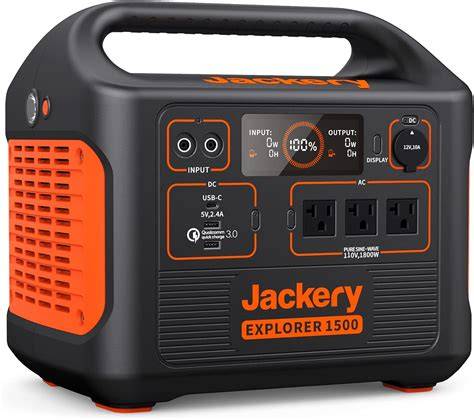
- Jackery Explorer 2000 v2: noticeably lighter for the same capacity class, so it wins if portability outranks surge headroom.
- Anker SOLIX F2000: a similar 2kWh LFP package with a strong app ecosystem and wheel-ready design.
If you want to step down in size and budget, a step-down BLUETTI model covers light outage duty at roughly half the capacity.
How the class compares
Published manufacturer specs, side by side. These are datasheet numbers, not our measurements.
| Model | Capacity | AC output | Weight | Chemistry |
|---|---|---|---|---|
| BLUETTI Elite 200 V2 | 2,080Wh | 2,600W | 53.5 lb | LiFePO4 |
| EcoFlow DELTA 2 Max | 2,048Wh | 2,400W | 51.6 lb | LiFePO4 |
| Jackery Explorer 2000 v2 | 2,042Wh | 2,200W | ~37 lb | LiFePO4 |
| Anker SOLIX F2000 | 2,048Wh | 2,400W | ~67 lb | LiFePO4 |
On paper, the Elite 200 V2 leads on continuous output by 200W and on surge headroom. It doesn’t lead on weight, and it doesn’t lead on expandability. If you’re weighing a smaller unit against this one, a rival 1kWh-class unit sits at a very different point on the size-versus-capacity curve.
How we researched this review
We don’t physically test the products we cover, and we won’t pretend otherwise. What we do is more useful for a big-ticket purchase like this: we read.
Our process for this piece started with BLUETTI’s official specification documentation and the user manual, then expanded to several hundred verified buyer reviews across purchase windows ranging from 30 days to 3 years. We sorted those reviews by complaint type to see which issues recur versus which are one-offs.
We also cross-referenced the safety framework. Portable power stations sold in the U.S. are commonly evaluated against UL 2743, the standard for portable power packs and stations, which covers cell-level protection, enclosure strength, and thermal cutoff behavior. It’s worth checking on any station you buy.
Finally, we compared published specs across the 2kWh class to see where the Elite 200 V2’s numbers actually sit rather than where marketing places them. Where a claim depended on real-world behavior, we deferred to aggregate buyer reports instead of datasheet theory.
Frequently Asked Questions (FAQ)
How long does the BLUETTI Elite 200 V2 take to charge?
Roughly 90 minutes from empty to full on a standard 15A household circuit, per manufacturer specifications. Verified buyer reports cluster between 80 and 100 minutes, which tracks. You can slow it down in the app if you want quieter operation or less heat, and charging from a 12V car outlet takes far longer, in the region of 20 hours.
Can it run a full-size refrigerator during an outage?
Yes, and this is the use case it’s built for. An 18 cu ft fridge drawing around 1,200Wh per day will run for roughly 20 to 30 hours before you need to recharge, depending on ambient temperature and how often the door opens. The 3,900W surge rating is what lets it start the compressor without faulting.
Is the Elite 200 V2 loud?
It’s silent under light loads, and noticeably audible under heavy ones. Charging a laptop or running a router produces effectively no sound. Above roughly 1,000W continuous, or during 1,200W AC charging, aggregate buyer reports describe a fan rush you’d notice in a quiet room.
It’s quieter than a generator by a wide margin.
What solar panels work with it?
Any panel array that fits the MPPT input window and stays under the 1,000W ceiling, which usually means three or four full-size rigid panels in series or a pair of high-output folding panels. Standard MC4 connectors are the norm. A single 200W folding panel works but charges slowly, taking most of a sunny day.
Can I use it as a UPS for a CPAP or desktop computer?
Yes, with a caveat. The UPS switchover is rated under 20ms, which is fast enough for most computers and all CPAP machines. Plug the device into the station, plug the station into the wall, and it passes through grid power while keeping the battery topped.
Just confirm your device’s draw fits comfortably under 2,600W.
How does the 5-year warranty actually work?
BLUETTI’s coverage runs 5 years from purchase and covers the battery, inverter, and control electronics. Verified buyers describe a process that starts with support diagnostics through the app, then moves to repair or replacement. Keep your order confirmation, since proof of purchase from an authorized seller is required and aftermarket purchases can be refused.
Final verdict
4.6/5 stars. The BLUETTI Elite 200 V2 is one of the better-balanced 2kWh power stations you can buy right now. It wins on surge headroom, charge speed, and battery chemistry, and it loses points only on weight and the missing expansion port.
Buy it if your goal is keeping a fridge, a furnace blower, and a router alive through a multi-day outage, or if you’re building a van setup that needs 2,600W on tap for cooking. Skip it if portability is your first priority or you plan to grow capacity later, because this chassis has no expansion path.
For everyone in the middle, the combination of a 4,000-cycle LiFePO4 bank, a 90-minute recharge, and enough inverter to start real appliances is genuinely hard to beat at this tier. That’s not hype; it’s what the spec sheet and the buyer data both say.
Affiliate disclosure: This post contains affiliate links. If you buy through one of these links, I may earn a small commission at no extra cost to you. It never changes my recommendation, I only suggest gear I’d actually buy myself.

Similar Posts




[…] comparison, the lighter Elite 200 stablemate sits closer to the 46 lb mark, and compact units like the Bluetti EB3A are a genuine one-hand […]